
Operational Technology (OT) networks, which control the physical processes of critical infrastructure—from power grids to manufacturing lines—were once isolated and secure through “air-gapping.” Today, the convergence of IT and OT has created unparalleled efficiencies but has also opened these sensitive environments to devastating cyber threats. A single successful intrusion can lead to disastrous operational downtime, physical damage, and compromised safety.
Traditional IT security solutions are inadequate for OT environments because they can inadvertently disrupt the delicate real-time communication of Industrial Control Systems (ICS). This is where Specialized OT Intrusion Detection Systems (IDS) come in. They provide non-intrusive monitoring, protocol awareness, and actionable intelligence to protect the “crown jewels” of industry.
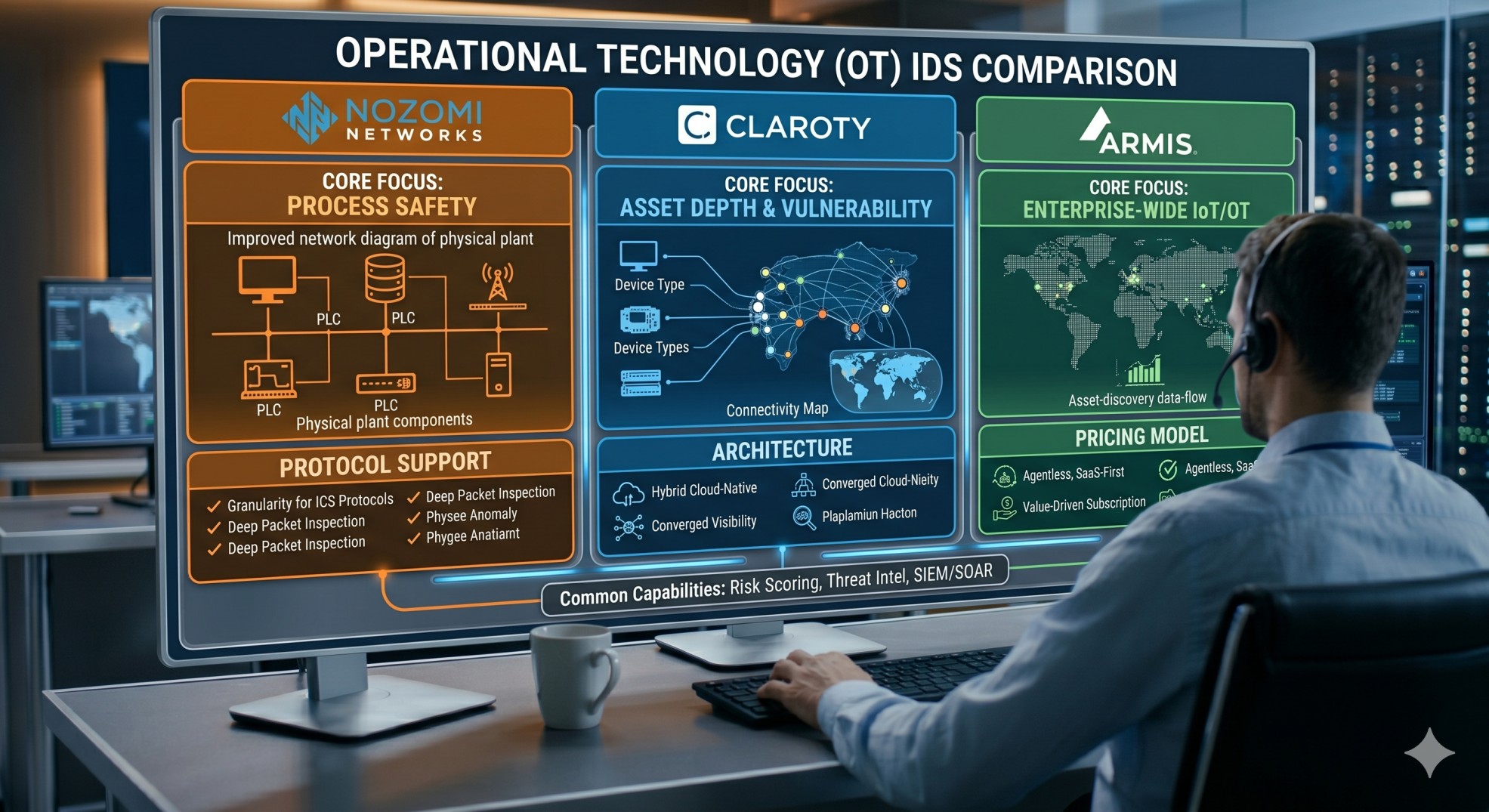
Choosing the right partner is crucial. This article compares three market-leading OT IDS solutions: Nozomi Networks, Claroty, and Armis.
The Contestants: At a Glance
The three vendors evaluated here all offer top-tier passive monitoring solutions but differ significantly in their origins, architectures, and primary strengths.
| Feature Group | Nozomi Networks | Claroty | Armis |
| Origin Story | Deep OT specialist | Deep OT specialist | IT/IoT Asset Management |
| Primary Strength | Process-level anomaly detection & safety | Full-spectrum integrated OT platform | Agentless visibility for “Enterprise IoT” |
| Architecture | On-prem appliance heavy (Cloud options) | On-prem or Hybrid (Cloud-native options) | Cloud-native, Agentless |
| Asset Discovery | Passive, deeply granular | Passive, extremely rich data | Broad, multi-vector discovery |
| Best For | Process-centric industries (Utilities, O&G) | Large-scale, integrated industrial security | Enterprises with mixed IT/IoT/OT environments |
In-Depth Analysis: The Key Pillars of Comparison
A comprehensive OT IDS evaluation centers on four main pillars: Asset Discovery, Threat Detection, Integration, and Architecture.
1. Asset Discovery and Visibility: You Can’t Protect What You Can’t See
In OT, visibility means knowing every device, vendor, serial number, firmware version, and communication path. A single unmanaged PLC is a potent entry point.
-
Claroty is often cited for its unprecedented level of asset context. Originally focused heavily on the engineering station and SCADA level, its “Continuous Threat Detection (CTD)” extracts rich metadata, building a digital twin of the environment. Claroty provides a clear line-of-sight from the enterprise level down into the most sensitive process control components.
-
Nozomi Networks provides equally excellent, passive, deep packet inspection. It is highly granular, identifying assets not just by type, but by the physical process they participate in. Nozomi’s capability to understand how an asset’s data fits into a process baseline is a core strength, making it ideal for safety-critical environments.
-
Armis takes a broader view. Its genesis in Enterprise IoT means it excel at identifying everything—from smart cameras and printers to medical devices and PLCs. It is a true “one tool to find them all” for environments where OT is integrated alongside pervasive IoT. However, its historical process-level depth may not be as mature as Claroty or Nozomi’s specialized protocol understanding.
2. Threat Detection: Signature vs. Anomaly
Effective OT IDS must detect known malware (signatures) AND new, targeted attacks (anomalies) without generating crippling false positives.
-
Nozomi Networks excels at anomaly detection, utilizing its foundational knowledge of the physical process. Its “Guardian” system creates a baseline of standard operations and communication patterns. If a PLC suddenly begins communicating with a novel external IP, or if its polling rate changes in an unsafe way, Nozomi is usually the first to raise an alert based on operational risk.
-
Claroty provides a highly robust, multi-layered threat detection engine. While strong on anomaly detection, its specialized threat intelligence feed, dedicated to ICS-specific vulnerabilities, is considered one of the best in the industry. It can identify subtle, targeted attacks (like Stuxnet variants) by combining behavior analysis with signature matching for specific OT protocols.
-
Armis approaches threat detection through a “behavioral baseline” derived from observing millions of devices in its global cloud database. It can compare a local PLC’s behavior against “known good” behavior for that exact device type seen globally. This provides a unique, crowd-sourced intelligence vector, but might lack the specific context of a highly customized local industrial process compared to the other two.
3. Integration and Ecosystem: The Force Multiplier
An IDS is an isolated sensor without a well-integrated ecosystem to ingest, correlate, and respond to its alerts.
-
Claroty has built a comprehensive, integrated platform. The platform is not just about detection but incorporates “Secure Remote Access (SRA)” and vulnerability management. It functions well as a centralized “OT Security Command Center,” making it a strong choice for large enterprises looking for an end-to-end solution. It integrates cleanly with all major SIEMs.
-
Armis is fundamentally a cloud-native platform designed for integration. Its asset-centric approach makes it the perfect foundational layer for other security tools. It has very strong, “out-of-the-box” bidirectional integrations with IT management platforms like ServiceNow, asset inventory systems, and extensive security orchestration tools (SOAR).
-
Nozomi Networks focuses on depth and provides mature integration capabilities. It integrates well with major SIEMs and SOAR platforms, feeding them rich, process-aware data. Nozomi’s ecosystem focus is on enhancing an organization’s existing SOC rather than attempting to replace it with its own platform command.
4. Architecture and Deployment: The Physical Reality
The sensitivity of OT means that a deployment’s physical footprint matters immensely.
-
Nozomi Networks has a traditional “hardware-heavy” origin, deploying “Guardian” passive appliances directly on-premise, often at every physical site. This model provides maximum local control, minimal latency, and zero required external connectivity, making it ideal for segmented critical infrastructure. They now offer hybrid and cloud management options.
-
Claroty is versatile. Their CTD solution can be deployed entirely on-premise as an appliance or virtual machine. They have also heavily advanced their cloud-native “xDome” platform, providing a scalable model for organizations that are more comfortable with hybrid architectures.
-
Armis is fundamentally cloud-native and agentless. It typically requires only light, local edge sensors (or existing network hardware) to replicate traffic to the Armis cloud for analysis. This minimizes the local footprint and makes deployment across highly distributed global sites much faster than the others. However, it requires outbound connectivity, which is often a deal-breaker for extremely secure OT segments.
Conclusion and Final Verdict
Choosing between Nozomi, Claroty, and Armis is not about finding the “best” product, but finding the “best fit” for your organization’s maturity, architecture, and vertical-specific risks.
-
Choose Nozomi Networks if: You manage high-risk, process-centric critical infrastructure (power, water, oil and gas) and require maximum local control, safety-critical process anomaly detection, and have strict segmentation requirements that favor an on-premise-first architecture.
-
Choose Claroty if: You are a large industrial enterprise seeking a comprehensive, integrated security platform that provides the richest possible asset metadata, leading ICS threat intelligence, and bundled remote access, and you have a mixed architecture that can accommodate both on-premise sensing and centralized management.
-
Choose Armis if: You are an enterprise with a highly converged IT/IoT/OT environment (manufacturing, healthcare, smart facilities) where visibility across the entire asset spectrum is the primary challenge, and you prioritize rapid, cloud-native deployment and ease of integration with your existing IT security stack.