
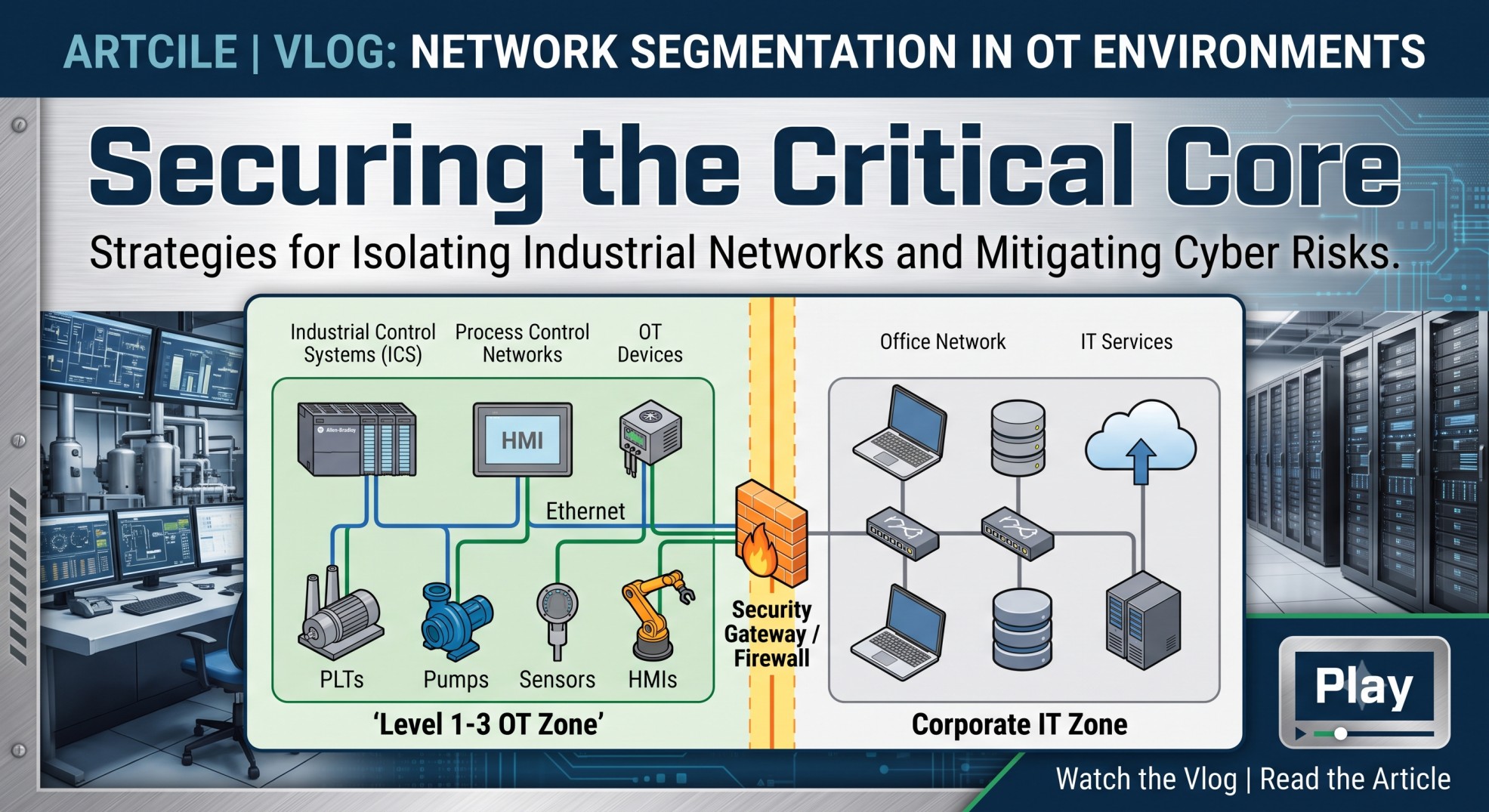
Building Digital Firebreaks: Why Network Segmentation is Critical for OT Security
As operational technology (OT) converges with enterprise IT and cloud analytics, flat, legacy industrial networks have become prime targets for cyber threats. Network segmentation is no longer just a best practice—it is the foundational defense mechanism required to isolate critical control assets and prevent lateral threat movement across production environments.
The Threat of Flat Industrial Networks
Traditionally, industrial control systems relied on air-gapping. Today, remote access, IIoT sensors, and enterprise reporting have interconnected OT systems directly with corporate networks. In a flat architecture, a single phishing email on the IT side or an infected field technician laptop can provide an adversary unrestricted access to programmable logic controllers (PLCs), distributed control systems (DCS), and safety instrumented systems (SIS).
Core Pillars of OT Segmentation
-
Zones and Conduits (IEC 62443): Group devices into logical “zones” based on operational function and risk level. Inter-zone communication must only pass through dedicated, strictly monitored “conduits.”
-
Industrial Demilitarized Zone (IDMZ / Level 3.5): Establish a strict buffer zone between IT and OT. No direct traffic should ever route between enterprise networks and Level 0–2 field devices.
-
Micro-Segmentation: Isolate critical assets within the same operational layer using next-generation firewalls (NGFWs) or software-defined perimeters to restrict east-west communication.
-
Zero-Trust Access & Jump Hosts: Enforce multi-factor authentication (MFA) and granular role-based access control (RBAC) via secure jump servers before granting access to engineering workstations or HMIs.
Comparing Segmentation Approaches
| Technique | Primary Function | Ideal Deployment |
| VLAN & Subnetting | Layer 2/3 traffic isolation | Basic boundary separation within plants |
| Stateful Industrial Firewalls | Deep Packet Inspection (DPI) for ICS protocols | Level 3.5 IDMZ and zone boundaries |
| Micro-Segmentation | East-west process-level containment | High-criticality PLC/DCS clusters |
| Data Diodes | Unidirectional deterministic data flow | Safety systems, plant historians to cloud |
Practical Implementation Steps
-
Map the Environment: Conduct comprehensive asset discovery and baseline all operational communication flows (e.g., Modbus, OPC UA, PROFINET, CIP).
-
Define Safety Boundaries: Separate basic process control systems (BPCS) from safety instrumented systems (SIS) to ensure life-safety logic remains completely isolated.
-
Implement “Allow-Only” Rulesets: Reject all default traffic. Allow only specific industrial protocol function codes (e.g., read-only vs. write commands) through conduits.
-
Upskill Engineering Teams: Enrolling plant engineers in specialized OT cyber security training for working professionals ensures that site teams understand zone architecture, industrial firewall policies, and secure maintenance protocols without causing unintended process downtime.
-
Continuously Monitor: Deploy passive network anomaly detection to identify unauthorized cross-zone communications without disrupting deterministic plant operations.
Isolating OT environments through robust segmentation ensures that a breach in the corporate sphere never results in downtime, equipment damage, or safety hazards on the plant floor.
For an overview of industry certifications and skill paths tailored for industrial engineers, check out this breakdown on Industrial (ICS/OT) Cyber Security Certifications.
This video is relevant because it walks through foundational ICS/OT credentials—such as SANS and ISA/IEC 62443—that validate core network segmentation and plant security skills for practicing engineers.