
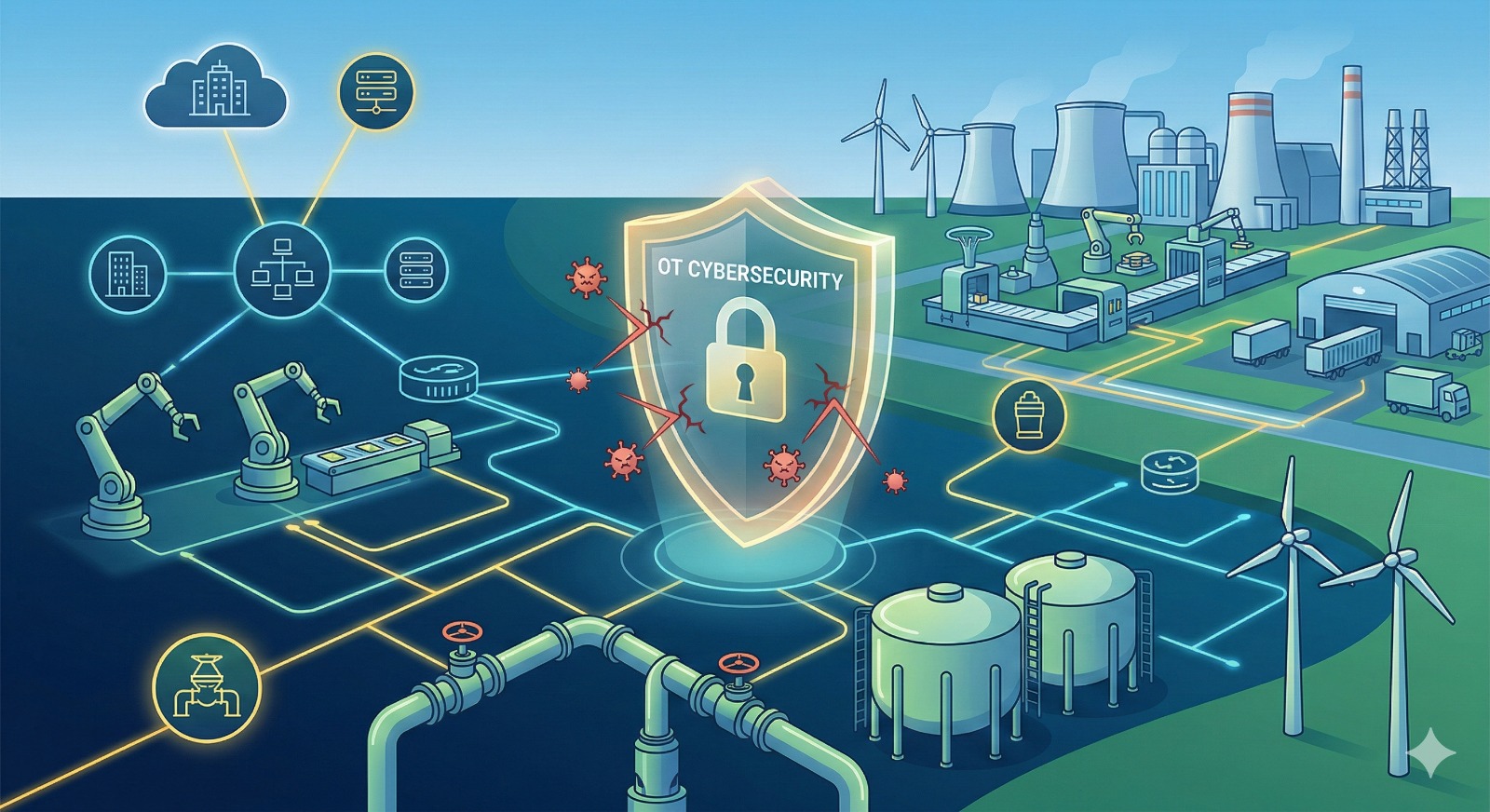
From the water flowing from your tap to the electricity powering your home, and the very production lines creating everything from cars to pharmaceuticals – the complex, interconnected world of modern industrial infrastructure relies heavily on Operational Technology (OT). Unlike information technology (IT), which manages data, OT is responsible for directly monitoring and controlling physical processes. For decades, these systems were isolated (the legendary “air gap”) but those days are gone. Today, OT is integrated, networked, and absolutely essential for modern industrial efficiency. This interconnectedness, while transformative, has ushered in a new era of risk: the vulnerability of OT to cyberattacks. Protecting these vital systems isn’t just a matter of good practice; it is a critical necessity for safety, economic stability, and national security.
Why is OT Critical?
OT encompasses a vast array of devices and systems:
-
Supervisory Control and Data Acquisition (SCADA) Systems: These provide high-level process supervision, like monitoring power grids or managing oil pipelines.
-
Programmable Logic Controllers (PLCs): These are the workhorses, executing real-time control functions on the factory floor, from assembling components to mixing chemical compounds.
-
Distributed Control Systems (DCS): Common in process industries (chemical plants, refineries), these coordinate numerous controllers for large-scale operations.
-
Industrial Internet of Things (IIoT) Devices: A growing array of connected sensors and actuators providing fine-grained data and control.
These systems are the backbone of critical infrastructure and essential manufacturing. If a bank’s IT system is hacked, credit cards might be compromised, causing disruption and financial loss. If a chemical plant’s OT is compromised, the results can be catastrophic: physical damage, environmental disasters, and potential loss of life.
The Rise of OT Vulnerabilities
Several factors contribute to the heightened vulnerability of modern OT systems:
1. Convergence of IT and OT (Industry 4.0): The promise of the Fourth Industrial Revolution (Industry 4.0) relies on the seamless flow of data between production lines (OT) and corporate networks (IT). While this drives efficiency, it also bridges the historic separation. A compromised IT system can now serve as an entry point into the OT environment, a phenomenon known as “pivoting.” The distinct skill sets and priorities of IT and OT personnel often lead to gaps in communication and security implementation.
2. Legacy Systems: Industrial equipment is built to last for decades. Consequently, many OT systems operate on outdated, unpatchable operating systems and lack modern security features. These legacy devices often communicate using insecure, unencrypted protocols that were designed for reliability in isolated networks, not security in a connected one.
3. Insecure by Design: Historically, OT systems were designed with functionality and safety as paramount, not security. Encryption, authentication, and access controls were often overlooked, creating open doors for attackers.
4. Difficulty of Patching: Patching critical OT systems can be extremely difficult. Down time is costly, and updates risk disrupting delicate processes or voiding vendor warranties. As a result, many systems go unpatched, leaving known vulnerabilities exposed for years.
5. Sophisticated Threat Actors: The motivations behind OT attacks range from financial gain (ransomware) to state-sponsored sabotage. Nation-states and organized cybercrime groups are developing sophisticated malware tailored specifically for OT environments, capable of manipulating physical processes with precision.
The Consequences of a Breach
The impact of an OT cybersecurity incident can be severe and far-reaching:
-
Physical Damage and Disruption: Attacks can cause machinery to malfunction, leading to product loss, equipment damage, and lengthy production shutdowns. In process industries, manipulating temperature or pressure controls can result in explosions, fires, or leaks.
-
Safety Hazards: Compromised control systems can pose direct risks to human life. Manipulating equipment settings can lead to accidents on the factory floor, while attacks on critical infrastructure can have devastating real-world consequences (e.g., compromising water treatment or power grids).
-
Economic Impact: Downtime in critical manufacturing or infrastructure sectors translates into significant financial losses. Supply chain disruptions can ripple through the economy, affecting multiple industries and consumers.
-
Reputational Damage: A high-profile breach can severely damage a company’s reputation, eroding trust among customers, partners, and regulators.
-
Geopolitical Instability: Attacks on national critical infrastructure (like power grids or transportation systems) are considered acts of cyberwarfare, with the potential to destabilize entire nations.
Real-World Examples
The threat is far from theoretical. Several significant OT-related cyberattacks have occurred in recent years:
-
Stuxnet (2010): A groundbreaking worm designed specifically to target Iranian nuclear enrichment facilities by subtly manipulating centrifuges. This attack demonstrated the potential for OT-specific malware to cause physical damage.
-
Ukraine Power Grid Attacks (2015 & 2016): These attacks, widely attributed to state-sponsored actors, involved compromising OT networks to remotely control substations and cut power to hundreds of thousands of customers during winter.
-
WannaCry (2017): While primarily targeting IT systems, this ransomware outbreak significantly disrupted numerous manufacturing companies (e.g., Renault-Nissan, Maersk) by affecting OT-related functions connected to corporate networks.
-
TRITON/Trisis (2017): A sophisticated malware campaign targeted the safety instrumented system (SIS) controllers at an oil and gas facility. This demonstrated a deliberate attempt to disable safety systems, a critical threshold in cyber warfare.
-
Colonial Pipeline Ransomware (2021): While the actual ransomware targeted the IT (billing) network, the company proactively shut down the OT side (pipeline operations) as a precaution, causing significant fuel shortages on the US East Coast. This highlighted how easily an IT compromise can impact critical infrastructure operations.
Securing the OT Environment: A Comprehensive Approach
Addressing OT cybersecurity requires a multi-layered approach that bridges the cultural gap between IT and OT and focuses on risk-based strategies. Key elements include:
1. Network Segmentation: Implementing robust network segmentation to separate the IT environment from the OT network. De-militarized Zones (DMZs) and industrial firewalls are critical for controlling traffic between these domains and preventing attackers from pivoting.
2. Visibility and Asset Inventory: You cannot protect what you cannot see. Establishing a comprehensive inventory of all OT assets, including legacy systems, is crucial. OT-specific monitoring tools can discover connected devices, baseline their behavior, and detect anomalies.
3. Risk Assessment and Prioritization: Conducting regular security assessments to identify vulnerabilities, giving priority to those that pose the greatest risk to safety and operational continuity.
4. Securing Remote Access: Remote access is necessary for maintenance and support, but it must be strictly controlled. Implementing multi-factor authentication (MFA), monitoring remote sessions, and restricting access to authorized personnel are essential measures.
5. Monitoring and Anomaly Detection: Implementing continuous monitoring of the OT network traffic to detect signs of compromise or unusual activities, such as attempts to modify control configurations or scan for vulnerabilities. Passive monitoring tools designed for OT environments are often preferred as they do not risk disrupting sensitive control systems.
6. Incident Response Planning: Developing a comprehensive incident response plan tailored for the OT environment. This plan must involve both IT and OT personnel and define clear roles, communication channels, and procedures for containing breaches and restoring operations safely. Regular drills and exercises are critical for maintaining preparedness.
7. Building Cybersecurity Culture: Fostering a culture of security awareness that encompasses both IT and OT personnel. Training should emphasize that security is a shared responsibility and that cybersecurity and safety are interconnected in the industrial context.
The Imperative of OT Cybersecurity
The convergence of IT and OT in modern industrial infrastructure offers immense benefits in terms of efficiency, optimization, and innovation. However, it also introduces unprecedented vulnerabilities that can have severe physical, safety, and economic consequences. Protecting these vital systems is no longer optional; it is a critical imperative for ensuring the resilience of our most fundamental services and manufacturing capabilities. The path forward requires a unified, strategic, and sustained commitment from industry leaders, security professionals, and policymakers. In the connected world of Industry 4.0, OT cybersecurity is not just an IT problem; it’s a foundation for our collective security and prosperity.