
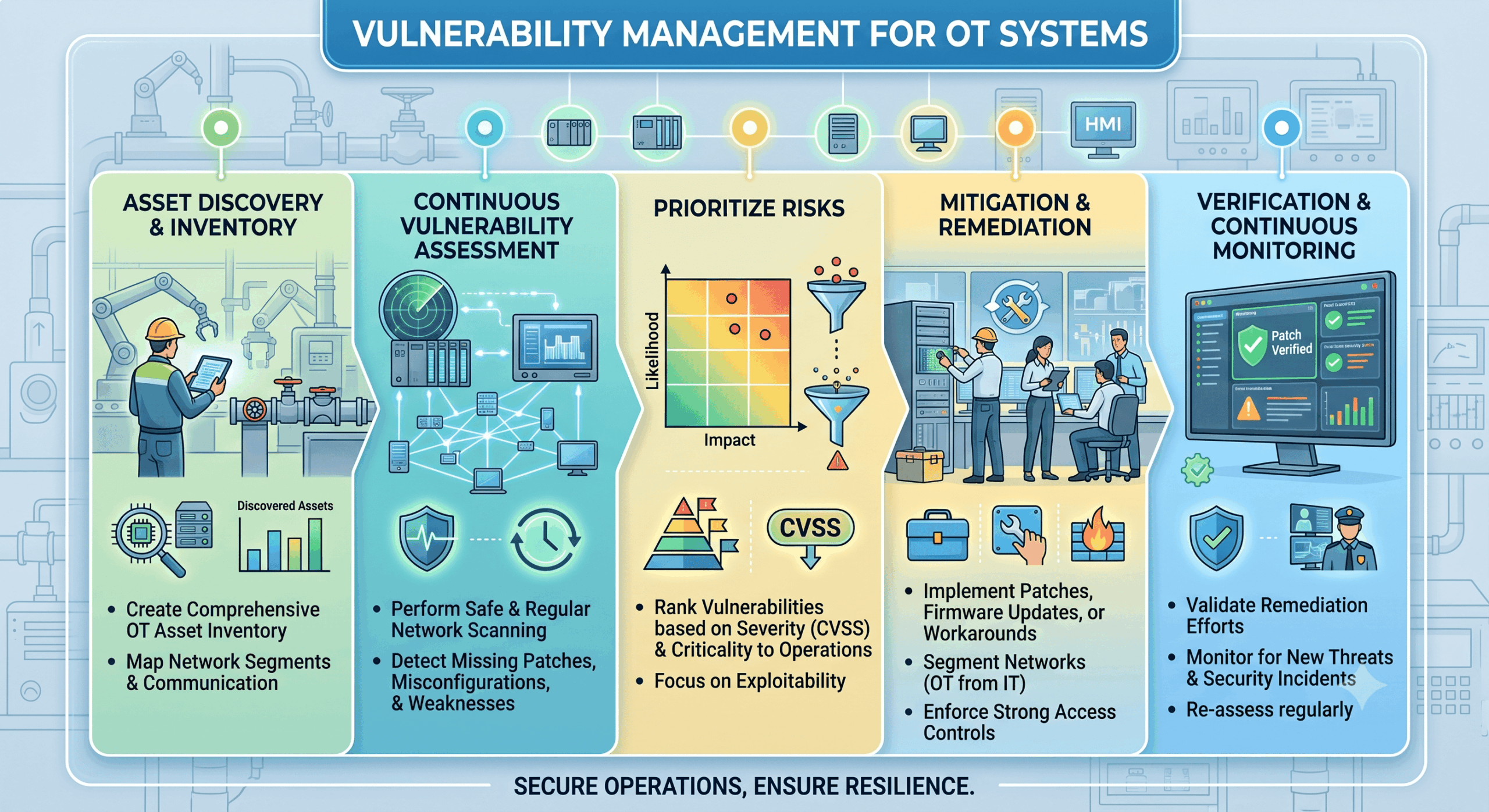
In today’s hyper-connected world, the gap between Information Technology (IT) and Operational Technology (OT) is rapidly closing. While this integration drives efficiency and innovation, it also exposes industrial environments—from power grids to manufacturing lines—to a new wave of cyber threats. Managing vulnerabilities within these critical OT systems is no longer optional; it’s essential for maintaining national security, public safety, and business continuity. This article, guided by our comprehensive infographic (Figure 1), explores the five critical steps to establishing a robust vulnerability management program for OT systems.
Understanding the OT/IT Divide: A Crucial First Step
Before diving into the methodology, it’s vital to recognize the fundamental differences between OT and IT security. IT priorities usually center on data integrity, confidentiality, and availability (the “CIA Triad”). For OT, the triangle is flipped, prioritizing safety, availability, and reliability above all else. This crucial distinction influences every phase of the vulnerability management process, demanding specialized tools, techniques, and mindsets. Traditional IT approaches, such as aggressive network scanning or rapid patch deployment, can disrupt sensitive industrial processes, leading to unplanned downtime or even physical danger.
Step 1: Asset Discovery and Inventory—You Can’t Protect What You Don’t See
The foundation of any successful vulnerability management program is a comprehensive and accurate asset inventory. However, in complex OT environments, this is often the most significant hurdle. Decades-old legacy systems sit alongside modern IoT devices, creating a sprawling, often undocumented ecosystem.
-
Create a Comprehensive OT Asset Inventory: This involves moving beyond a simple list of IP addresses. For each device, you must identify its make, model, firmware version, and communication protocols. In OT, this requires specialized discovery techniques.
-
Active vs. Passive Discovery: While active scanning (sending queries to devices) is standard in IT, it can crash sensitive OT equipment. Passive monitoring, which non-intrusively analyzes network traffic, is typically safer and more effective for discovering the baseline of OT systems. Some advanced tools offer “safe active scanning” that mimics approved protocol communication.
-
Map Network Segments and Communication: Understanding the communication paths between devices is critical. This maps out potential attack vectors and helps implement effective network segmentation—a vital defense mechanism.
Step 2: Continuous Vulnerability Assessment—Navigating the Minefield
Once you have a baseline inventory, the next challenge is accurately identifying potential vulnerabilities. This step is far more complex in OT than simply running an automated scan.
-
The Risk of Scanning: Inadverent damage is the top concern. Vulnerability assessment in OT must be conducted with extreme caution. Passive monitoring, again, plays a central role. By analyzing network traffic patterns and protocol anomalies, passive tools can identify vulnerabilities without directly touching the devices.
-
Specialized OT Security Tools: These tools integrate with industrial protocols (like Modbus, PROFINET, and EtherNet/IP), allowing them to understand the operational context and identify weaknesses that a standard IT scanner would miss.
-
Leveraging Vendor Information: Many OT vulnerabilities are disclosed by the vendors themselves via security advisories. An effective VM program must automatically correlate its asset inventory with these advisories.
Step 3: Prioritize Risks—Drowning in a Sea of Vulnerabilities
In modern industrial environments, the number of identified vulnerabilities can be overwhelming. Attempting to fix every issue is a guaranteed path to failure. Remediation efforts must be prioritized based on risk, a complex calculation that differs significantly from IT.
-
Move Beyond the CVSS Score: The Common Vulnerability Scoring System (CVSS) is a foundational tool, but a simple score of “9.0” doesn’t tell the whole story in an OT context.
-
Operational Criticality: A vulnerability on a device that controls a critical safety function is vastly more important than a similar vulnerability on an isolated HMI (Human-Machine Interface). Prioritization must consider the potential impact on safety and operational availability.
-
Likelihood and Exploitability: How easy is it for an attacker to exploit the vulnerability? A vulnerability that requires physical access is less of a risk than one that can be exploited remotely. Prioritization models must account for these factors, often using a risk matrix like the one in our infographic (Figure 1).
Step 4: Mitigation and Remediation—More Than Just Patching
The ultimate goal of vulnerability management is reducing risk. However, remediation in OT isn’t as straightforward as just applying a patch.
-
Patching is Not Always the First Option: Patching an OT device often requires a planned maintenance outage, which may only happen once a year. In some cases, a patch might not even be available for decades-old equipment. This requires a shift from a “patch everything” mentality to a “compensating controls” strategy.
-
Compensating Controls: When patching isn’t feasible, you must implement alternative security measures to reduce the likelihood or impact of an attack. This is where OT security truly shines. Strategies include:
-
Network Segmentation: Isolate the vulnerable device or network from other systems, especially the internet and the corporate network.
-
Strict Access Control: Implement “least privilege” principles and robust authentication for interacting with critical devices.
-
Firewall Rule Tuning: Deep packet inspection (DPI) firewalls can be configured to block malicious traffic that would exploit known vulnerabilities, effectively creating a “virtual patch.”
-
-
Apply Patches When Feasible: Patching should still be the desired outcome, but it must be meticulously planned and tested in a staging environment to ensure it doesn’t negatively impact operational integrity.
Step 5: Verification and Continuous Monitoring—A Continuous Cycle, Not a One-Time Project
Vulnerability management is not a task you complete; it’s a constant, cyclical process.
-
Validate Remediation Efforts: Once a patch is applied or a compensating control is implemented, you must verify its effectiveness. Did it truly fix the vulnerability without creating a new problem? Passive monitoring tools can play a key role here by confirming that specific network behaviors associated with an exploit have stopped.
-
Establish a Feedback Loop: Use the knowledge gained from each remediation cycle to improve your asset inventory, assessment processes, and prioritization logic. The key is to constantly learn and adapt.
-
Monitor for New Threats: Vulnerabilities are discovered daily. New attack techniques emerge constantly. Continuous network monitoring—using both traditional security tools (IDS/IPS) and specialized OT behavior analytics—is essential to spot emerging threats and react quickly to new zero-day vulnerabilities.
Conclusion: Security as an Enabler
Vulnerability management for OT systems is an undeniable challenge, requiring specialized skills, tools, and a safety-first mindset. However, by embracing the five-step framework of asset discovery, assessment, prioritization, mitigation, and continuous monitoring, industrial organizations can build a foundation of resilience.
Security should not be seen as a roadblock, but as a critical enabler of the digital transformation. A secure and robust OT environment ensures business continuity, protects valuable assets, and, most importantly, keeps people and processes safe. The journey to secure operations and ensured resilience begins with a commitment to an effective, specialized vulnerability management program.