
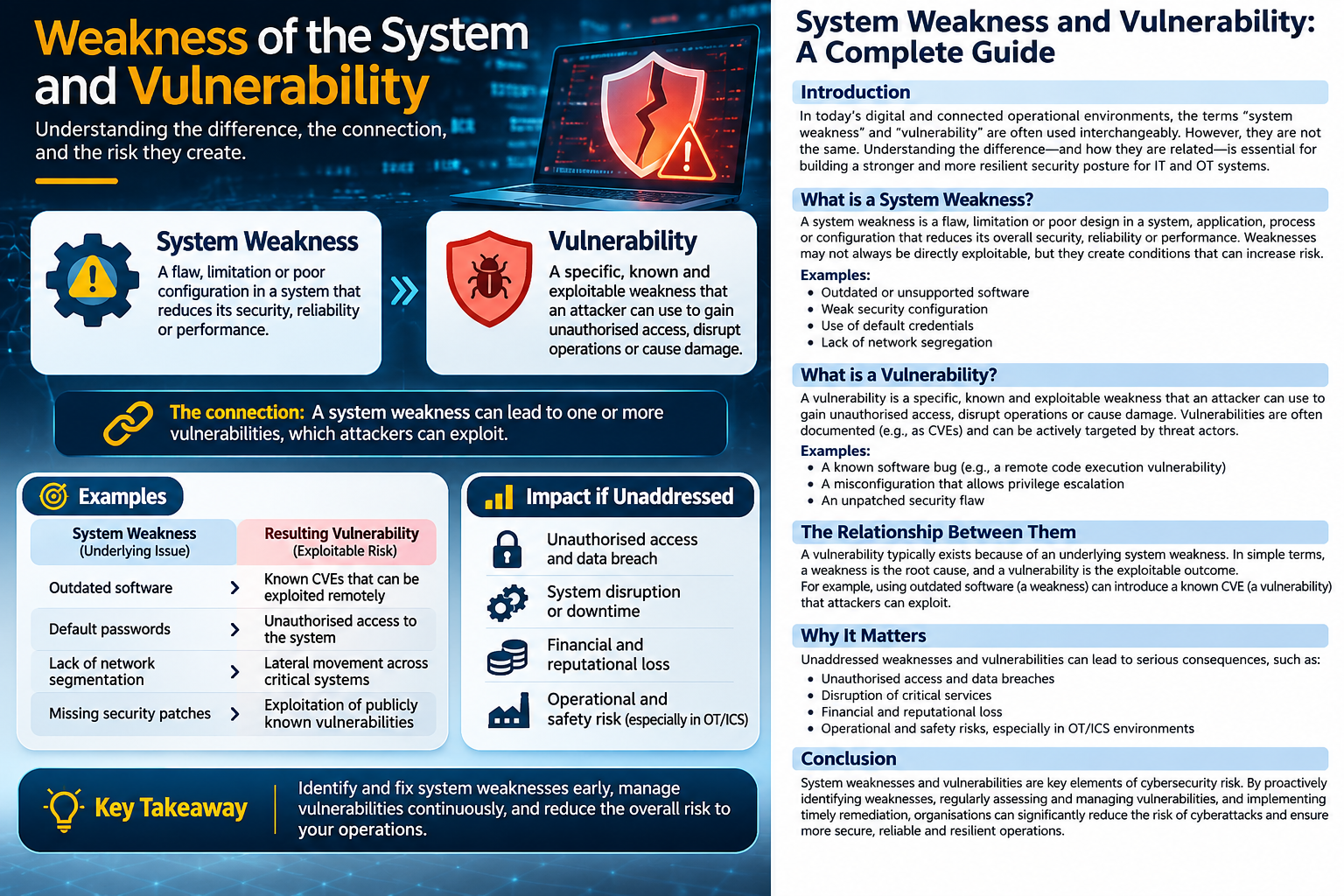
How identifying hidden security weaknesses can help organisations prevent cyberattacks, protect critical infrastructure, and strengthen their overall cybersecurity posture.
1. Introduction: Why System Security Matters More Than Ever
In today’s interconnected digital world, organisations depend heavily on information technology, cloud computing, industrial automation, digital communication networks, and intelligent applications to operate efficiently. From banking and healthcare to manufacturing, energy, transportation, and government infrastructure, technology plays an essential role in everyday business operations.
However, increasing dependence on digital systems also introduces significant cybersecurity challenges.
Every operating system, application, network, database, industrial controller, and connected device has the potential to contain security weaknesses. If these weaknesses remain unidentified or unaddressed, they can create opportunities for cybercriminals to compromise systems, steal sensitive information, interrupt essential operations, or cause financial and reputational damage.
Cybersecurity incidents do not always occur because attackers develop sophisticated techniques. In many cases, attackers take advantage of existing security gaps such as outdated software, weak passwords, incorrect configurations, excessive access privileges, and insufficient security monitoring.
These weaknesses can expose an organisation to ransomware attacks, data breaches, malware infections, unauthorised access, and operational disruptions.
Therefore, understanding system weaknesses and cybersecurity vulnerabilities is fundamental to developing a strong cybersecurity strategy.
Organisations must move beyond simply installing security tools and adopt a proactive approach that continuously identifies, evaluates, prioritises, and addresses security weaknesses.
The objective of cybersecurity is not merely to respond to attacks after they occur, but to reduce opportunities for attackers before security incidents happen.
2. What Is a System Weakness in Cybersecurity?
A system weakness refers to a deficiency, flaw, limitation, or ineffective security control within an information system, application, network, or organisational process.
Such weaknesses may arise during system design, software development, deployment, configuration, maintenance, or daily operations.
A weakness does not always represent an immediately exploitable security vulnerability. However, it can create conditions that increase the likelihood of system compromise.
Common Examples of System Weaknesses
Weak Authentication Mechanisms
Systems that rely on easily guessed passwords, shared user accounts, or inadequate authentication controls may become vulnerable to unauthorised access.
Outdated Software
Unsupported operating systems and applications may contain security flaws that are no longer addressed by their vendors.
Improper Security Configurations
Misconfigured firewalls, cloud services, servers, and network equipment can unintentionally expose critical services or sensitive information.
Insufficient Network Segmentation
When networks lack appropriate segmentation, attackers who compromise one system may gain access to additional systems.
Excessive User Privileges
Granting employees or applications unnecessary administrative privileges increases the potential impact of compromised accounts.
Inadequate Monitoring
Organisations without effective logging, threat detection, and security monitoring may struggle to identify suspicious activities in a timely manner.
Poor Security Awareness
Employees unfamiliar with phishing, social engineering, and safe data-handling practices may inadvertently create security risks.
These weaknesses demonstrate that cybersecurity involves much more than technology alone. People, processes, governance, and organisational policies are equally important.
3. What Is a Vulnerability in Cybersecurity?
A cybersecurity vulnerability is a weakness in a system, application, security control, or operational process that can be exploited or triggered to compromise confidentiality, integrity, or availability.
Vulnerabilities may exist in software code, hardware components, network configurations, authentication mechanisms, application interfaces, and industrial control environments.
When attackers successfully exploit vulnerabilities, they may gain unauthorised access, retrieve confidential information, execute malicious commands, manipulate data, or disrupt system operations.
Common Types of Cybersecurity Vulnerabilities
1. Software Vulnerabilities
These involve security flaws in applications, operating systems, libraries, or other software components.
Examples include buffer overflows, insecure deserialisation, and remote code execution flaws.
2. Network Vulnerabilities
Weak network configurations, unnecessary open ports, insecure services, and inadequate network access controls may expose systems to attacks.
3. Web Application Vulnerabilities
Web applications may contain weaknesses such as SQL injection, cross-site scripting, broken access controls, and insecure authentication.
4. Authentication Vulnerabilities
Weak password policies, insecure session management, and authentication bypass flaws may enable attackers to access protected resources.
5. Configuration Vulnerabilities
Incorrect security settings, exposed storage resources, default credentials, or excessive permissions can create exploitable conditions.
6. Industrial Control System Vulnerabilities
Industrial environments may contain vulnerable PLCs, SCADA components, engineering workstations, Human-Machine Interfaces (HMIs), and industrial communication systems.
Exploitation may lead to operational disruption, loss of visibility, or unauthorised manipulation of industrial processes.
Understanding these vulnerability categories helps security teams identify where threats may originate and which defensive measures are most appropriate.
4. Difference Between System Weaknesses and Vulnerabilities
Although the terms are closely related and sometimes overlap, they have important conceptual differences.
A system weakness is generally a flaw or deficiency that reduces security effectiveness.
A vulnerability is a weakness that creates an exploitable or otherwise actionable security condition.
For example, an organisation may have an ineffective software maintenance process. This represents a system or process weakness.
If the organisation consequently operates a server containing an exploitable software flaw, that flaw represents a vulnerability.
| System Weakness | Cybersecurity Vulnerability |
|---|---|
| A deficiency in system design, configuration, implementation, or operation | A weakness that can be exploited or triggered to compromise security |
| May or may not be directly exploitable | Creates an exploitable or actionable security condition |
| Can involve people, processes, or technology | Can occur in software, hardware, configurations, controls, or operational practices |
| Example: Poor patch-management procedures | Example: An unpatched remote code execution flaw |
| Addressed through security improvements and corrective controls | Addressed through remediation, mitigation, or risk treatment |
Importantly, the distinction is not absolute. Certain conditions, such as default credentials or exposed administrative services, may be described as both weaknesses and vulnerabilities.
The critical objective is to understand the security risk they create and implement appropriate protective measures.
5. How Attackers Exploit System Weaknesses
Cybercriminals frequently identify weaknesses through reconnaissance, exposed services, publicly available vulnerability information, stolen credentials, and other attack-surface discovery methods.
Once a potential weakness is identified, an attacker may attempt to exploit it to gain access to a system.
Consider a hypothetical organisation operating a customer management application.
The application server has not received security updates for an extended period. A publicly disclosed vulnerability affects its installed software version.
If the vulnerable service is accessible and appropriate protective controls are absent, an attacker may exploit the vulnerability to obtain unauthorised access.
After compromising the server, the attacker could attempt to access additional systems, retrieve sensitive information, or disrupt operations.
An Illustrative Cyberattack Sequence
- Discovery: An attacker identifies an exposed application or service.
- Weakness Identification: The attacker determines that the system contains an exploitable vulnerability.
- Initial Compromise: The vulnerability is exploited to gain unauthorised access.
- Privilege Escalation: The attacker attempts to obtain additional permissions.
- Lateral Movement: The attacker searches for access to other connected systems.
- Impact: The attacker may steal data, deploy ransomware, or disrupt services.
Not every attack follows this sequence, and multiple security controls can interrupt an attack at different stages.
This highlights the importance of defence in depth, where multiple layers of security reduce reliance on any single protective mechanism.
6. Major Causes of System Weaknesses
Cybersecurity weaknesses can emerge from technical shortcomings, organisational decisions, human error, and inadequate security governance.
A. Poor System Design
Applications and infrastructure developed without security considerations may contain architectural weaknesses that are difficult to address after deployment.
Security should be incorporated from the beginning of the system development lifecycle.
B. Lack of Regular Updates
Software vendors regularly release updates to address identified security flaws.
Organisations that delay updates without implementing alternative protections may remain exposed to known vulnerabilities.
C. Human Error
Incorrect system configurations, accidental exposure of sensitive information, insecure credential handling, and improper access permissions can introduce security weaknesses.
D. Inadequate Security Policies
Without clear security policies and defined responsibilities, organisations may struggle to enforce consistent access controls, configuration standards, and incident response procedures.
E. Legacy Systems
Older infrastructure may rely on unsupported software, obsolete communication protocols, or outdated authentication methods.
Legacy equipment is particularly common in industrial environments where systems are designed to remain operational for many years.
F. Limited Security Visibility
An organisation cannot effectively secure assets it does not know exist.
Incomplete asset inventories, unmanaged devices, and inadequate monitoring can leave important systems outside security management processes.
G. Weak Third-Party Security
Suppliers, contractors, service providers, and external technology integrations may introduce additional security exposure.
Organisations should consider third-party connections and dependencies when evaluating their cybersecurity posture.
7. The Impact of Vulnerabilities on Organisations
Unaddressed vulnerabilities can affect business operations, customer trust, regulatory compliance, and long-term organisational resilience.
Data Breaches and Information Theft
Attackers may exploit security vulnerabilities to access customer information, financial records, business strategies, intellectual property, and other confidential data.
The consequences may include privacy violations, legal obligations, incident response expenses, and loss of customer confidence.
Financial Losses
A successful cyberattack can create direct and indirect financial consequences.
These may include system restoration costs, operational downtime, external investigation expenses, legal fees, lost revenue, and contractual penalties.
Ransomware Incidents
Attackers may use vulnerabilities or compromised credentials to gain initial access before deploying ransomware.
Ransomware can interrupt business operations by encrypting information, disabling services, or threatening the disclosure of stolen data.
Operational Disruption
In sectors such as manufacturing, utilities, healthcare, and logistics, system disruption can interrupt essential processes and service delivery.
Reputational Damage
Customers and business partners expect organisations to protect sensitive information.
Repeated security failures or poorly managed cybersecurity incidents can significantly reduce confidence in an organisation.
Safety and Critical Infrastructure Risks
Within industrial environments, cybersecurity incidents may affect processes connected to physical equipment.
Under certain conditions, compromised systems can create equipment damage, environmental consequences, or threats to personnel safety.
These risks make cybersecurity an essential component of operational risk management.
8. System Weaknesses and Vulnerabilities in OT/ICS Cybersecurity
Operational Technology (OT) and Industrial Control Systems (ICS) are widely used in manufacturing facilities, power plants, oil and gas operations, water treatment facilities, transportation infrastructure, and other industrial sectors.
These systems monitor and control physical processes.
Common OT components include:
- Programmable Logic Controllers (PLCs)
- Distributed Control Systems (DCS)
- Supervisory Control and Data Acquisition (SCADA) systems
- Human-Machine Interfaces (HMIs)
- Engineering workstations
- Industrial servers and historians
- Remote Terminal Units (RTUs)
- Industrial network and communication devices
Unlike conventional enterprise IT environments, OT systems frequently prioritise availability, process integrity, reliability, and physical safety.
As industrial systems become increasingly connected to enterprise networks, remote-access platforms, and cloud environments, cybersecurity weaknesses may create additional operational exposure.
Common OT Cybersecurity Weaknesses
Legacy Operating Systems
Older engineering workstations and industrial applications may run on unsupported operating systems.
Insecure Industrial Protocols
Some industrial communication protocols were designed without modern authentication or encryption capabilities.
Inadequate IT/OT Network Segmentation
Improperly controlled communication between corporate IT and industrial networks can increase the potential for attacks to spread.
Uncontrolled Remote Access
Poorly secured vendor connections and remote maintenance services can create entry points into industrial environments.
Weak Asset Visibility
Industrial operators may lack a complete inventory of controllers, network devices, software versions, and connected assets.
Default or Shared Credentials
Shared engineering accounts and unchanged default passwords can weaken accountability and access control.
Limited Security Monitoring
Traditional IT security tools may not provide complete visibility into specialised industrial communications and process activity.
Why OT Vulnerability Management Requires Special Care
Applying patches or performing aggressive vulnerability scans in an industrial environment can introduce operational risks if compatibility and process safety are not considered.
Therefore, OT vulnerability management should use an operationally informed, risk-based approach.
This may include passive asset discovery, safe configuration reviews, vendor consultation, maintenance-window planning, network segmentation, secure remote access, and testing changes before deployment.
Frameworks and guidance such as IEC 62443 and NIST SP 800-82 can support organisations in developing appropriate industrial cybersecurity programmes.
In OT cybersecurity, protecting availability and safety is just as important as preventing unauthorised access.
9. Vulnerability Assessment: Identifying Security Gaps Before Attackers Do
A vulnerability assessment is a systematic process used to identify, analyse, and evaluate security weaknesses across an organisation’s technology environment.
The objective is to understand which vulnerabilities exist, how they could affect the organisation, and which corrective actions should receive priority.
Key Stages of a Vulnerability Assessment
Stage 1: Asset Identification
Identify servers, workstations, applications, cloud resources, network devices, industrial controllers, and other relevant technology assets.
Stage 2: Security Discovery
Use authorised and appropriate assessment techniques to discover potential vulnerabilities and configuration weaknesses.
Stage 3: Vulnerability Analysis
Determine which findings are genuine, identify affected systems, and understand the conditions necessary for exploitation.
Stage 4: Risk Evaluation
Assess vulnerabilities based on technical severity, asset criticality, exposure, potential business impact, and available threat information.
Stage 5: Reporting and Recommendations
Prepare a structured assessment report explaining findings, risks, and recommended remediation measures.
Stage 6: Remediation and Verification
Correct identified weaknesses, apply suitable mitigations, and verify that the implemented measures are effective.
A vulnerability assessment should not be treated as a one-time exercise.
New assets, software updates, configuration changes, and emerging vulnerabilities continuously change an organisation’s security exposure.
Consequently, regular reassessment is important for maintaining an effective cybersecurity posture.
10. Understanding CVE, CWE, and CVSS
Several widely used cybersecurity systems help organisations classify, document, and prioritise vulnerabilities.
Common Vulnerabilities and Exposures (CVE)
CVE provides standard identifiers for publicly disclosed cybersecurity vulnerabilities.
A CVE identifier helps vendors, security teams, researchers, and organisations refer to the same vulnerability consistently.
However, a CVE identifier does not automatically indicate that every organisation is affected or that exploitation is occurring.
Common Weakness Enumeration (CWE)
CWE categorises common software and hardware weakness types.
Examples include improper input validation, inadequate access control, and weaknesses in authentication or memory handling.
Understanding CWE categories can help development teams address recurring security problems at their root.
Common Vulnerability Scoring System (CVSS)
CVSS provides a standardised way to express characteristics and technical severity of vulnerabilities.
Scores can help security teams evaluate findings, but should not be used as the sole basis for remediation decisions.
A technically severe vulnerability on an isolated noncritical system may represent a different organisational risk from a moderate-severity vulnerability affecting an internet-facing critical application.
Effective prioritisation must therefore consider the actual operational environment.
11. Why Vulnerability Severity Is Not the Same as Risk
One of the most important concepts in cybersecurity is the difference between vulnerability severity and organisational risk.
A vulnerability may receive a high technical severity score, but the actual risk depends on several additional factors.
These include:
- Whether the affected system is exposed to potential attackers
- Whether exploitation techniques are publicly available
- Whether the vulnerability is being actively exploited
- Whether compensating security controls are implemented
- The criticality of the affected asset
- The potential impact on business operations
- The sensitivity of the information processed by the system
- The consequences for safety, reliability, and service availability
For example, a vulnerability affecting a publicly accessible payment processing application may require more urgent remediation than an identical vulnerability affecting an isolated laboratory system.
Similarly, a vulnerability affecting a critical industrial safety-related environment may demand special attention even when its technical severity score is not exceptionally high.
Therefore, cybersecurity teams should adopt risk-based vulnerability prioritisation rather than relying exclusively on severity scores.
This approach helps organisations direct their resources towards the vulnerabilities most likely to cause meaningful harm.
12. Best Practices for Preventing and Managing System Vulnerabilities
A strong cybersecurity programme combines technical security controls with organisational governance, employee awareness, and continuous improvement.
1. Maintain a Complete Asset Inventory
Organisations should identify and document the systems, applications, software components, network devices, and connected equipment they operate.
Accurate asset visibility is the foundation of effective vulnerability management.
2. Conduct Regular Security Assessments
Periodic vulnerability assessments, configuration reviews, and authorised penetration tests help organisations identify security gaps.
Assessment frequency should reflect asset criticality, exposure, regulatory obligations, and the rate of environmental change.
3. Implement Effective Patch Management
Establish procedures for evaluating, testing, approving, and deploying security updates.
For systems that cannot be patched immediately, alternative controls such as network restrictions or enhanced monitoring may reduce exposure.
4. Apply the Principle of Least Privilege
Users and applications should receive only the permissions necessary for their authorised activities.
Review privileged accounts regularly and remove unnecessary access rights.
5. Strengthen Authentication
Implement strong authentication controls, including multi-factor authentication where appropriate, and eliminate unnecessary shared accounts.
Administrative access and remote connections should receive particular attention.
6. Establish Network Segmentation
Separate critical infrastructure and sensitive environments from less trusted networks.
Appropriate segmentation reduces unnecessary connectivity and may limit the movement of attackers after an initial compromise.
7. Implement Continuous Security Monitoring
Collect and analyse relevant logs, security alerts, network activity, and endpoint information.
Monitoring capabilities should support timely detection, investigation, and incident response.
8. Secure Cloud and Remote Access Environments
Review cloud configurations, identity permissions, externally accessible services, and remote-access arrangements.
Security controls should reflect the organisation’s responsibility within each technology environment.
9. Provide Cybersecurity Awareness Training
Regular training helps employees recognise suspicious emails, social engineering attempts, unsafe downloads, and inappropriate handling of sensitive data.
An informed workforce can contribute significantly to the organisation’s security culture.
10. Develop and Test Incident Response Plans
Organisations should prepare for security incidents by establishing response procedures, communication responsibilities, evidence-handling practices, recovery plans, and escalation mechanisms.
Incident response exercises can help identify gaps before a real attack occurs.
11. Protect Backups and Recovery Capabilities
Maintain reliable backups of critical systems and information.
Backup protection, isolation, restoration testing, and recovery procedures are essential for reducing the impact of destructive cyber incidents.
12. Continuously Review Security Controls
Security requirements evolve as organisations adopt new technologies, change business processes, and connect additional systems.
Regular security reviews help ensure that protective measures remain effective.
13. The Role of Cybersecurity Frameworks and Standards
Internationally recognised standards and frameworks can help organisations manage cybersecurity weaknesses systematically.
ISO/IEC 27001
Provides requirements for establishing, implementing, maintaining, and continually improving an Information Security Management System (ISMS).
ISO/IEC 27002
Provides guidance on information security controls that organisations can consider when treating security risks.
NIST Cybersecurity Framework (CSF)
Supports cybersecurity risk management through the functions Govern, Identify, Protect, Detect, Respond, and Recover.
NIST SP 800-53
Provides a catalogue of security and privacy controls for information systems and organisations.
IEC 62443
Addresses cybersecurity for industrial automation and control systems, including organisational processes, system security, and component-level security requirements.
NIST SP 800-82
Provides guidance for securing operational technology environments while considering their performance, reliability, and safety requirements.
These standards and frameworks help organisations develop structured security practices rather than relying entirely on individual products or isolated technical measures.
However, compliance with a particular standard does not guarantee immunity from cyberattacks.
Effective cybersecurity requires continuous implementation, monitoring, evaluation, and improvement.
14. The Importance of Proactive Vulnerability Management
Traditional security approaches often focus on responding to incidents after an organisation experiences an attack.
Although incident response remains essential, reactive security alone is insufficient.
Proactive vulnerability management aims to reduce the opportunities available to attackers before exploitation occurs.
A mature vulnerability management programme should address the complete vulnerability lifecycle:
Discover → Assess → Prioritise → Remediate → Verify → Monitor
Each stage contributes to reducing uncertainty and improving security decision-making.
Benefits of Proactive Vulnerability Management
Reduced Attack Surface
Identifying unnecessary services, exposed systems, weak configurations, and unsupported software allows organisations to minimise potential entry points.
Improved Business Continuity
Addressing critical vulnerabilities can reduce the likelihood of system compromise and operational disruption.
Better Resource Allocation
Risk-based prioritisation helps security teams focus on the most important vulnerabilities rather than treating every finding equally.
Stronger Regulatory Readiness
Documented assessments, remediation decisions, and security controls can support compliance and audit requirements.
Improved Organisational Resilience
Organisations with effective security and recovery capabilities are better positioned to withstand and recover from cyber incidents.
A proactive approach transforms vulnerability management from a technical checklist into an ongoing business risk management function.
15. The Growing Challenge of Emerging Technologies
Digital transformation introduces new opportunities for businesses, but it also expands the environments that organisations must protect.
Cloud computing, Internet of Things (IoT) devices, artificial intelligence, industrial automation, and interconnected supply chains create complex technology ecosystems.
These environments may introduce new vulnerabilities and make existing weaknesses more difficult to identify.
Cloud Computing
Cloud systems can suffer from excessive permissions, insecure interfaces, exposed data storage, and configuration errors.
Organisations must understand their responsibilities for protecting cloud workloads, identities, applications, and data.
Internet of Things
IoT devices may operate with limited security capabilities, outdated firmware, weak authentication, or inadequate update mechanisms.
Because these devices are often distributed across different environments, maintaining visibility and security can be challenging.
Artificial Intelligence Applications
AI-enabled systems may introduce risks involving sensitive data exposure, insecure integrations, prompt injection, and inappropriate access to connected tools or information.
Security practices must evolve to address these new application-level risks.
Industrial Digital Transformation
The convergence of IT and OT networks increases opportunities for operational efficiency, predictive maintenance, and remote monitoring.
However, increased connectivity also requires stronger security architecture, access management, and protection of industrial communication pathways.
As technology evolves, organisations must continuously update their threat models, security architectures, and vulnerability management processes.
16. Building a Strong Cybersecurity Culture
Technology alone cannot eliminate cybersecurity weaknesses.
An organisation may implement advanced firewalls, endpoint protection, and vulnerability scanning tools, yet still experience security incidents if employees, contractors, and leadership do not follow appropriate security practices.
A strong cybersecurity culture requires active participation across the organisation.
Senior management should recognise cybersecurity as a business responsibility and provide adequate resources for risk management.
IT and OT teams should collaborate to understand system dependencies and operational security requirements.
Employees should receive practical security awareness training and understand how to report suspicious activity.
Software developers should incorporate secure coding practices into development processes.
Procurement and vendor-management teams should assess cybersecurity considerations when introducing third-party technologies and services.
Clear accountability, communication, and collaboration can help reduce weaknesses that cannot be resolved through technical controls alone.
Cybersecurity should become part of everyday organisational decision-making rather than an isolated responsibility assigned only to security professionals.
17. The Future of Vulnerability Management
Cybersecurity vulnerability management is becoming increasingly continuous, intelligence-driven, and integrated with broader enterprise risk management.
Organisations are moving towards approaches that combine asset visibility, vulnerability intelligence, threat information, automated workflows, and business context.
Several developments are particularly important.
Continuous Exposure Management
Organisations increasingly evaluate their overall exposure rather than relying exclusively on periodic vulnerability scans.
Risk-Based Remediation
Security teams prioritise vulnerabilities according to potential exploitation, asset importance, and business consequences.
Automation
Automated asset discovery, security validation, ticket generation, and remediation tracking can improve efficiency and consistency.
Secure-by-Design Development
Security requirements are increasingly incorporated into software architecture, product design, and technology procurement.
Greater IT/OT Collaboration
Industrial organisations are strengthening collaboration between cybersecurity specialists, engineering personnel, and operations teams to protect connected infrastructure.
Third-Party Risk Management
As businesses rely on external software, cloud platforms, and service providers, supply-chain security and vendor assurance are becoming increasingly important.
The overall direction is towards security programmes that continuously identify changing exposure and support informed risk decisions.
Nevertheless, human expertise remains essential for interpreting findings, understanding operational consequences, and approving appropriate security actions.
18. Conclusion: Identify Weaknesses Before They Become Cybersecurity Incidents
System weaknesses and vulnerabilities are unavoidable challenges in modern digital environments.
As organisations expand their technology infrastructure and adopt increasingly connected systems, the number and complexity of potential security exposures continue to grow.
An unpatched application, poorly configured firewall, weak authentication mechanism, vulnerable industrial controller, or uncontrolled remote-access connection can create opportunities for cyberattacks.
However, the existence of weaknesses does not mean that a successful attack is inevitable.
Organisations can substantially reduce their exposure by establishing effective cybersecurity governance, maintaining asset visibility, performing regular assessments, implementing appropriate security controls, and prioritising remediation according to risk.
For industrial organisations, cybersecurity measures must also respect operational reliability, system availability, equipment compatibility, and physical safety requirements.
Most importantly, cybersecurity should be viewed as an ongoing organisational commitment rather than a one-time project.
Security controls must evolve alongside business operations, technology changes, and emerging threats.
A resilient organisation is not simply one that possesses advanced security tools. It is one that understands its weaknesses, evaluates its risks, takes appropriate corrective action, and continuously improves its defensive capabilities.
The most effective time to identify and address a system vulnerability is before an attacker exploits it.